EDLINKS® is proud to release the New Whole Child Model. At a time when educators, families, and communities are seeking ways to support not only academic success, but also wellbeing, purpose, resilience, and human flourishing, this model offers a unifying approach for understanding and nurturing the development of human beings while also informing the systems and cultures in which learning and growth take place.
Drawing on the traditional Whole Child framework, Benard's and Truebridge's Theory of Resilience, Viktor Frankl's foundational work on meaning-making, William Damon's research on purpose, Lisa Miller's scholarship on spirituality, and Abraham Maslow's later work on transcendence, the New Whole Child Model brings together complementary bodies of scholarship that illuminate a developmental journey from resilience to meaning, from meaning to purpose, from purpose to spirituality, from spirituality to transcendence, and ultimately toward altruism and contribution to the greater good.
Woven throughout the model is a throughline of purpose and spirituality that provides meaning in what students are learning. Consistent with Viktor Frankl's belief that the search for meaning is a fundamental human motivation, the model recognizes that learning is most powerful when individuals can connect knowledge and experience to a deeper sense of purpose, identity, and contribution. At its core, this spiritual dimension reflects the inward life of a person—the place where experience is interpreted and the self is formed and evolves. Through this lens, learning becomes more than the acquisition of knowledge and skills; it becomes a journey of understanding oneself, connecting with others, and discovering how one can contribute to something greater than oneself.
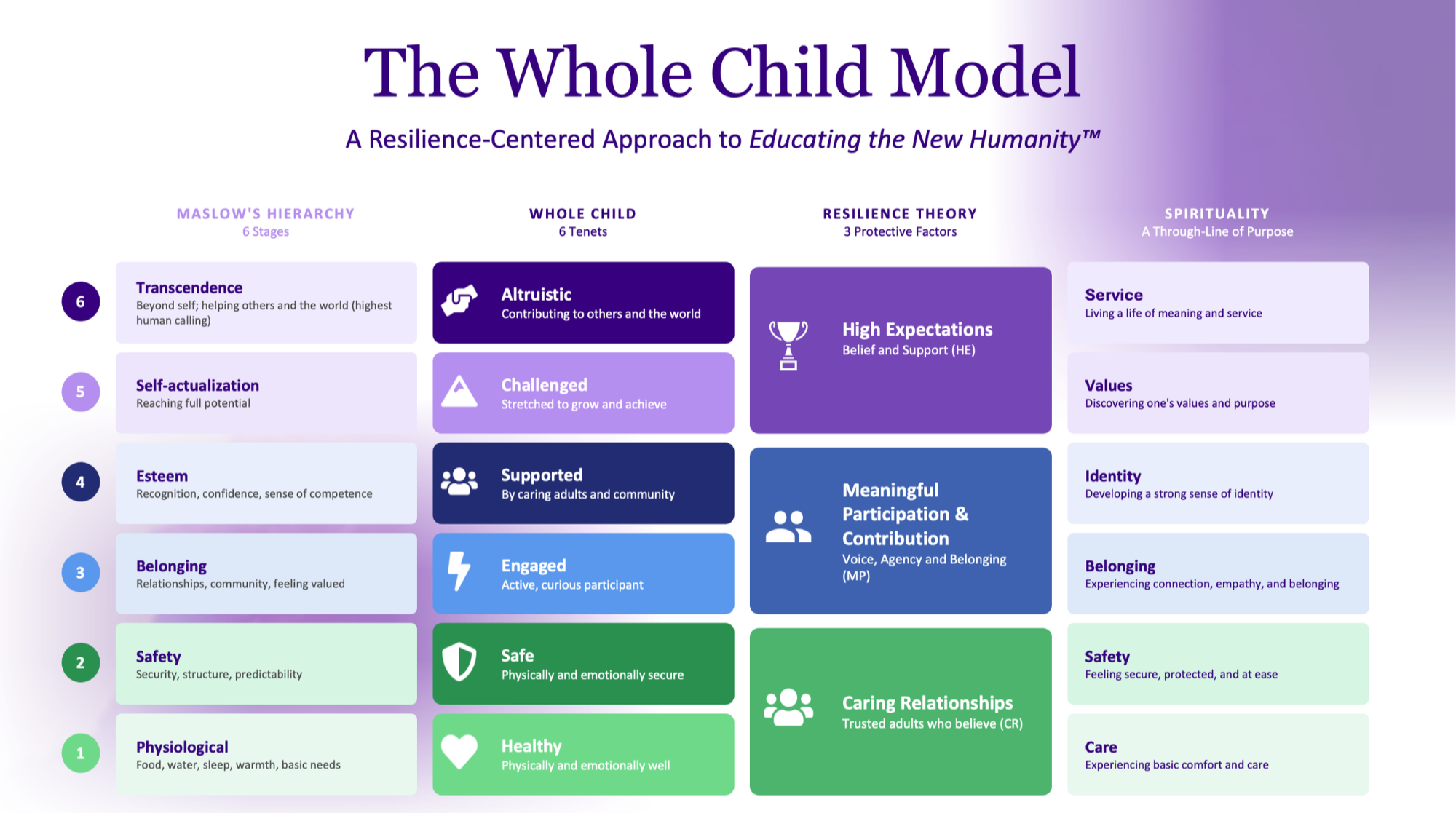
This expanded understanding of human development is grounded in a substantial body of research. The New Whole Child Model asks not only whether students are learning, but also whether they are Healthy, Safe, Engaged, Supported, Challenged, and Altruistic. Resilience Theory, grounded in the work of Bonnie Benard and advanced by Dr. Sara Truebridge, demonstrates that schools can intentionally foster resilience by creating environments rich in caring relationships, meaningful opportunities to participate and contribute, and high expectations. From that foundation, Viktor Frankl's work on meaning-making highlights the human need to make sense of experiences and discover significance in life, including during times of adversity. Building on meaning, William Damon's research demonstrates that students who develop a clear sense of purpose and direction experience stronger outcomes across academic, social, emotional, and developmental domains. Lisa Miller's research on spirituality further suggests that a healthy spiritual life—characterized by meaning, connection, purpose, and a sense of something larger than oneself—contributes to wellbeing, resilience, mental health, and human flourishing across the lifespan. Maslow's later work on transcendence extends this developmental journey beyond personal achievement and self-actualization toward connection, service, and contribution to something greater than oneself.
The New Whole Child Model brings these complementary bodies of scholarship together into a unified framework for education. In this model, resilience provides the foundation for growth; meaning helps individuals interpret their experiences; purpose provides direction; spirituality deepens connection to self, others, and something larger than oneself; and transcendence points beyond personal fulfillment toward service and contribution. The model culminates in altruism—the willingness and capacity to help others beyond oneself for the greater good. Altruism is not simply an additional dimension of development; it is the fullest expression of whole child development and the destination toward which the other dimensions are building.
The research that informs the New Whole Child Model points toward a common understanding: the conditions schools create, the relationships they foster, and the opportunities they provide for growth and meaning-making are not peripheral to learning; they are foundational to it. Schools that educate the whole child, support the whole educator, and strengthen the whole school community create the conditions not only for achievement, but also for human flourishing and contribution to the greater good. In doing so, they help advance the larger vision of Educating The New Humanity™ to Awaken and Lift Humanity to See Good. Do Better.